Showing posts with label exhibitions. Show all posts

Tuesday, October 21, 2014

Mickalene Thomas: I was born to do great things

Mickalene Thomas’ I was born to do great things is an unconventional portrait of Sandra Bush, the artist’s late mother and muse. The presentation at Kavi Gupta is split into two spaces. A traditional, white cube gallery containing vitrines and art-adorned walls is contrasted with a gallery space evocative of a 1970’s living room, with mismatched furniture, wood paneling, and linoleum tile. The show’s title is a quote from Thomas’ mother-muse. “I was born to do great things” speaks to Bush’s views of herself and brings to the forefront identity, a major theme of the exhibition. Though the sculptures and paintings are a visual reminder of her mother, a short documentary in the den gallery delves into Bush’s melancholic feelings of regret for not succeeding at a career in modeling, which is countered with pride in acting as her daughter’s muse.

Image c/o Kavi Gupta Gallery
In the main gallery, Thomas intersperses her mother’s artifacts – a tube of lipstick, Chinese dolls, jewelry – with works made by the artist that were inspired by her mother’s larger-than-life personality. These artifacts were collected from her mother’s home following her death in 2012, and act as a proxy for her maternal presence. Having been used by Bush to shape her identity, they come to exemplify her exquisite style and grace.
Image c/o Kavi Gupta Gallery
The most provocative works in the show were sculptures cast in bronze: a jacket, loose hanging sweater, a pair of jeans, a bra, and Crocs. In removing these items from her mother’s home and transforming them into bronze sculptures, Thomas is memorializing her mother in a format reserved for historical greats – a fitting tribute to a woman who continues to inspire an entire artistic practice.
Image c/o Kavi Gupta Gallery

Tuesday, October 7, 2014

Universal Declaration of Infantile Anxiety Situations Reflected in the Creative Impulse: My Barbarian at Gallery 400

Motherhood and the anxieties associated with it are the core themes of Universal Declaration of Infantile Anxiety Situations Reflected in the Creative Impulse at Gallery 400. The exhibition highlights the work of My Barbarian, a collective comprised of Malik Gaines, Jade Gordon, and Alex Segade. The works in the show were accompanied by two live performances of an adaptation of Bertolt Brecht’s 1932 play, The Mother, in which a radicalized depiction of motherhood is explored.

Untitled

From the moment I entered the industrial space of Gallery 400, I was confronted by the sharp triangular stage – a wooden construction jutting a sharp pointed angle directly at the entrance. This introduction to the show is arresting, the downward pointing triangular shape of the stage recalling the symbol of femininity and womanhood. This object is central to a show intent on understanding motherhood and redefining gender roles in the modern era.

Though the exhibition doesn’t have many works in it, it feels complete. Flanking the stage are works that directly relate to the performance. On the left are drawings made of oil stick on brown paper crudely depicting masks, set designs, and violent statements like “YOUR SON HAS BEEN SHOT.” Each drawing is clearly handmade. There is nothing mechanical about the art, though some of the drawings depict factories and laborers – giving humanity to the labor movement, a theme that is later called out in the performance of The Mother.

Untitled

The opposing wall holds thirteen papier mâché masks used in My Barbarian’s performances. The masks are sculptural, evoking classical Greek theatre, each depicting a character performed by members of My Barbarian. Upon closer viewing, the papers used to plaster the masks are reproductions of 1930’s Russian newspapers, a reference to the era in which Brecht composed The Mother, a play framed by the Bolshevik Revolution.

Untitled

In two smaller galleries are video installations, one of which plays My Barbarian’s performance of The Mother in a continuous loop. This video acts as a proxy for the actors throughout the show’s run, although two performances occurred mid-September. The performances rounded out the exhibition in its ability to activate the objects in the space and personified the themes of motherhood, revolution, labor, and artistic practice that each iteration of My Barbarian’s work explores.

The Mother takes place in 1917 Russia, and portrays a mother, Mrs. Vlassova, in relationship to her rebel son Pavel. The action of the play occurs on the triangular stage and the masks become physical aids in storytelling. Gaines, Gordon, and Segado wear neutral off-white work clothes including coveralls, caps, and work boots. Though they appear to match, each of their costumes is distinct - their individuality is highlighted. The story takes place in a series of locations including the kitchen of Mrs. Vlassova, the factory where Pavel works, a prison, a teacher’s home, and sites of protest outside of the factory. The drawings are activated during the performance, projected onto the wall behind the stage to set the scene for each location.

  Untitled

The performance was punctuated by songs from the original play set to musical arrangements by Gaines. Employing theatrical tactics, My Barbarian exploits musical styles, dance, and inflections in the actors’ voices and bodies to tell the story of Mrs. Vlassova’s place in the revolution. Tied solely to the domestic space of her home, she is introduced to the revolution through her son Pavel who works in a factory. Pavel’s desire to fight for better wages involves his mother giving both her emotional and physical support. She aids the revolution through her words and her actions, eventually leaving her home to complete covert operations for the revolutionary effort, visit her son in prison, and even join in the violent protest marches.

The success of the performance lies in the liberties My Barbarian took with their interpretation of the original. The performers play multiple characters in the story. Each takes a turn at playing the mother. Even the audience has a chance to perform the mother through call and response at the end of the performance. In this way My Barbarian suggests that all people have a “maternal instinct” and the place a mother may have in stirring revolution. Revolutions don’t emerge from thin air – they are birthed, weaned, and grown. Through neutralizing costumes, the use of masks, and simplistic use of set design, My Barbarian is able to tell the story of revolution while simultaneously remarking upon the importance of the mother in nurturing social justice.

Tuesday, September 23, 2014

Rapid Response Collecting: A Practice in Wall Texts for Contemporary Collecting

Rapid Response Collecting in an exhibition at the Victoria and Albert Museum that is pioneering a critique of contemporary culture through the act of carefully collected and curated objects. In examining objects that have been selected to represent contemporary culture, the curators of the V&A are turning the focus from objects of the past (typically associated with museum display practice), in favor of turning an eye toward objects of the present. In singling out a contemporary artifact for the permanent collection, the curators are keeping objects that may potentially capture this moment in time for future generations to observe and form an understanding of what will become the impending past.

Some of the objects currently on display at the V&A include:
  • A 3D Printed Handgun
  • A pair of Primark cargo trousers, made in Bangladesh
  • A set of Katy Perry false eyelashes
  • Christian Louboutin shoes in five shades of "nude"

In response to Rapid Response Collecting, my Writing for Exhibitions course had each of us select three objects that represent the here and now of contemporary culture. Accompanying the pieces of our selection are succinctly written wall texts to aid in framing the objects on display.


9/11 Memorial Museum Commemorative Cheese Platter
2014

This controversial cheese platter in the shape of the United States marks the three locations where the 9/11 terrorist attacks occurred. When the 9/11 Memorial Museum opened its doors on May 21, 2014, the tray wasn’t part of an exhibit—it was sold through the gift shop. There was an immediate public outcry over the object’s questionable taste, and the platter was quickly removed from the shelves. The 9/11 platter raises questions about the types of retail items museum stores choose to sell: is there a line between commemorative object and kitschy souvenir?


Stock photo from the launching of HealthCare.gov
2013

On October 1, 2013 the Affordable Care Act launched the HealthCare.gov website. The problem was the website didn’t work. Users were greeted by the smile of a mysterious woman—a stock photo image that soon became an icon of the website’s unsuccessful launch. In the days that followed HealthCare.gov’s debut, millions of people tried and failed to purchase healthcare. The anonymous woman’s smiling face served as an ironic counterpart to the public’s frustration with a broken, ineffectual website. At the same time, this now-iconic image also symbolizes the start of health insurance reform in this country.


Unworn Hazmat Suit (2014 Ebola Outbreak)
2014

“The personal protective equipment we wore in the Ebola Treatment Unit becomes excruciatingly hot, with temperatures inside the suit reaching up to 115 degrees. It cannot be worn for more than an hour and a half.” – Dr. Kent Brantly

While working in West Africa Dr. Kent Brantly treated patients with the Ebola virus and, after contracting the disease, became a patient himself. After testing positive for Ebola Brantly returned to the US for treatment. His treatment led to  worldwide media coverage of the virus, a response to him being white and American with a disease afflicting predominantly West Africans.

As of September 2014, an estimated 2,630 people have died from what is now known to be the worst Ebola virus breakout in history. Doctors are fighting tirelessly to contain the disease, but it shows no signs of slowing.


To see the rest of the entries written by members of the Museum and Exhibitions Studies Program at UIC, please check out our Tumblr. 

Thursday, September 18, 2014

This Weekend: Art Events, Exhibitions, Openings in Chicago

This weekend is the premiere art-going gallery-hopping weekend in Chicago. Between tonight and Sunday evening, I'm hoping to visit the Art Institute of Chicago, Kavi Gupta, the Sullivan Galleries, Antena, EXPO Chicago, Gallery 400, and the Museum of Contemporary Art. Take a deep breath with me, there doesn't that feel better?

Here's a rundown of what I will be doing, seeing, snapping photos of, oggling at, and potentially reviewing:

Magritte: The Mystery of the Ordinary, 1926-1938 
The Art Institute of Chicago // June 24 - Oct. 16, 2014

Clairvoyance (La Clairvoyance), (1936) via Art History News Report
The final days of the major Magritte retrospective are upon us, and with that I am visiting the Art Institute for one final viewing of his work. Surrealism has a tendency to be off-putting, with the jarring imagery that seems to stand outside of time or place. Using the techniques laid out by Renaissance artists like trompe l'oeil, Magritte employs his talent for painting "the real" and turning it on its head. As a viewer, standing before his work is arresting. It's difficult to comprehend, breathtaking, satisfying and unsatisfying all at once. I'm looking forward to immersing myself in his paintings, sculptures, and works on paper one final time.

Kavi Gupta Gallery // Sept. 19 - Nov. 15, 2014 

Image via Kavi Gupta Gallery
"I was born to do great things are the quoted words of Sandra Bush, Mickalene Thomas's late mother, a statement that speaks for both the dynamic life that she lived as well as her influence and inspiration on Thomas's artistic practice as her longtime muse. Bush has been prominent as a subject in Thomas's works over the past 14 years, inspiring her examinations of identity and style through her magnetic personality and undeniable presence. This presentation of new work explores the personal story of the woman behind the inspiration. This is a story in celebration of womanhood, motherhood, and the power of art as a totem for personal memory, a story in celebration of Sandra." - Kavi Gupta Gallery

Earlier this year, Mickalene Thomas released a documentary about her mother as her artistic muse. It looks incredibly moving, with heartfelt conversations relating Thomas' work to her close relationship with her mother, Sandra.


A Proximity of Social Consciousness: Art and Social Action
SAIC Sullivan Galleries // Sept. 20 - Dec. 20, 2014

Morgan Shoal: Lake Bottom Land Use by Dan Peterman image
via A Lived Practice
"At the core of Chicago’s intellectual and creative life stand these influential artists for whom this city itself was a springboard for a new way of thinking about art at the intersection of society. Their work has influenced generations, having made social practice a worldwide phenomenon. Now this exhibition brings their ideas alive through 10 newly commissioned projects. Exhibiting artists: Jim Duignan, Pablo Helguera (BFA 1993), Iñigo Manglano-Ovalle (MFA 1985), Dan Peterman, Pocket Guide to Hell, J. Morgan Puett (BFA 1981), Michael Rakowitz, Tamms Year Ten, Temporary Services, and Rirkrit Tiravanija (MFA 1986)."
 - The Sullivan Galleries

A Home coming: videos by Cara Megan Lewis and Alejandro Figueredo Diaz-Perera
Antena // Sept. 19 - Oct. 11, 2014

Photographic still from Antena

"The comfort of “home” is exploited in the three video works featured in the exhibition A Home coming. Each video is situated in a liminal, transitory space that complicates otherwise familiar places and implicates the role of the voyeur, blurring the distinction between reality and fiction. The exhibition will feature a collaborative artwork, and one individual work by each of the artists. 

For their individual works, both Cara and Alejandro appropriated existing “home videos.” For Cara’s video installation Let’s Do It, edited footage from a 1990 home music video - originally made in collaboration with her father - raises questions of early sexual awareness and depicts the fine line between confidence and self consciousness. Alejandro’s video on the other hand abstracts an overtly sexual video clip from a homemade porn he found online, offering a humorous perspective on that which is usually confined to the private realm. 

The setting of their collaborative video installation Cul-de-Sac is a subdivision of more than 100 houses all in the same state of construction. The timeless music box melody accompaniment implies a history and offers a counterpoint to the otherwise cultural void depicted in the footage of the construction site. The hypnotic video exposes the skeleton of a yet-to-be populated, already-scripted homogenous society that prizes superficial appearance over true quality." 
- Antena

EXPO Chicago
Navy Pier // Sept. 19 - Sept. 21, 2014

View of EXPO Chicago, 2012 via Navy Pier
If you can't make it to every single gallery, but want a slice (albeit, massive) of what is happing in the art world right now, buy a ticket to EXPO and run wild. 140 galleries representing 17 countries in 43 cities will be showing hundreds of works of art. It's a feast for the eyes as well as the senses, a massive space to immerse yourself in the art world.

My Barbarian Collective Performs "The Mother"
Gallery 400 // Sept. 19 (7 pm) and Sept 20. (3 pm)

A moment from "The Mother" via The Visualist
"My Barbarian performs a live staging of their adaptation of Bertolt Brecht’s 1932 play, "The Mother." Telling the story of a working-class mother who becomes increasingly radicalized on the eve of the Bolshevik Revolution, the play centers on the power of the affective maternal relationship to foster social change. My Barbarian is a collective consisting of artists Malik Gaines, Jade Gordon, and Alexandro Segade. Founded in Los Angeles in 2000, My Barbarian combines elements of theater and visual art to create interdisciplinary works in video, music, performance, drawing, and sculpture."
- Gallery 400

MCA Talk: Curating Bowie
The Museum of Contemporary Art // Sept. 21, 2014 (1-2 pm)

Photograph via The MCA
"David Bowie Is* curators Victoria Broackes and Geoffrey Marsh, from the Victoria and Albert Museum in London, present an overview of the exhibition and discuss Bowie’s life and work" 
- The MCA

Wednesday, May 21, 2014

Isa Genzken Retrospective at the Museum of Contemporary Art Chicago

Untitled
My little feet on a floor installation outside of the exhibition

Last night I visited the Isa Genzken Retrospective which recently opened at the MCA Chicago. It was free night, the show was so new I could still smell the paint and plaster, a smell I fondly reminisce about and miss frequently since my departure from the Art Institute. I walked into the show knowing nothing about Genzken, and impulse joined a group tour with a docent. We were greeted by her most recent works, a grouping of mannequins dressed in a variety of outfits to create an "environment" near the entrance of the exhibition space. But upon entering the show-proper, we stepped back in time, confronted with Genzken's early works - minimal, abstract geometries, a single readymade, photography, and video installation.

Untitled
This self portrait contains two photos of Leonardo DiCaprio
as well as a photo of Andy Warhol. I approve.

Even early on, Genzken was working in a diverse manner. The curators and art historians describe Genzken as "post-medium" in that she works outside of the constraints of a single medium, opting in favor of sculpture, assemblage, film, photography, collage, and painting. But what I took away from the exhibition was that outside of being post-medium, Genzken is an an artist with two distinctive movements, pre-9/11 and post-9/11. The early works are clearly influenced by the minimalists who predate her, and her desire to breakout of that preexisting artistic practice. She experiments with form, color, and abstraction, always with a punchiness and sense of humor to her manner of work. She moves from clean mathematically precise woodwork, to bare bones concrete sculptures that feel both jiltingly cool and oddly disarming. Her work draws the viewer in, through familiar materials, eye-level installations, the use of windows, and quirky feelers that break the "fourth wall" bringing the viewer into the space of the work.

Untitled
Pages from her New York scrapbook, images of her being a laid back, goofy, woman who loves New York.

As she moves through the 1990's, Genzken changes locale, falling in love with New York City. Her love for the city makes itself apparent in her architectural sculptures which seem to capture the color, fast-paced, exotic, thrilling danger of living in the city. Many of the works from this period are assemblages full of color and humor, not as painstakingly focused on clean mathematical construction, but rather on capturing the feeling of being in the city.

Untitled
Post-9/11 work

But then the horrific events of 9/11 occurred and we see a shift in Genzken's work. The city she loved and called home was under attack, and in response, Genzken's works evokes a darker more violent persona. Splashes of red pop from grays and silver, recalling the layer of ash that rained down on the Financial District when the Twin Towers collapsed. The carnage and destruction was ever present in the mind of the New Yorker, and so it was ever present in Genzken's work. Anxiety, violence, destruction, and war all make themselves apparent in her post-9/11 work. The isolation of being a person in this dark new world is a theme that repeats itself through the final rooms of the exhibition, leaving the viewer with a haunting self-awareness that is so different from the color and whimsy we are greeted with upon entering the exhibition.

Untitled
NASA astronauts survey the remains of abandoned
suitcases in this jilting environmental installation.

It is difficult not to walk out of this exhibition with 9/11 on the brain. With the opening of the 9/11 Memorial Museum at Ground Zero this past week, I've found myself engrossed in the various press, critiquing the opening of a museum upon an active burial site. Criticisms of the steep admission price ($24), or of the museum having a gift shop in which one can purchase 9/11 museum "souvenirs" amid a city of people who are still very carefully picking up the pieces from a tragic, confusing, destructive day. Genzken's response to 9/11 still feels fresh and raw, but she finds moments of color and lightness through the tragedy as she sorts through her own experiences from that day, and the days that followed. Her work, in that is it post-9/11 work created by a non-American lends a new approach and different view of a day in history that will forever stain our memories. 9/11 belongs to the world, our world, and she won't let us forget it.

Tuesday, April 22, 2014

Box Count: Fifteen

Untitled
Last week we crossed a major threshold, 1,000 photographs archived! And to celebrate, while poring over photographs of Montana, Mexico, Kashmir, Iowa, Wisconsin, and New York, we happily poured ourselves a glass of bubbly to commemorate such a happy milestone in the project.

Cheers to 1000 photos being archived!

I'm keeping my eyes peeled for images of pool halls for Andrew, while simultaneously making mental notes of repeated motifs. I'm leaning heavily toward photographs depicting food, kitchens, and market places... I feel like a gourmet photography show could be such a fun thing for us to do. I'm even daydreaming of organizing a potluck or enlisting food trucks at the opening, well this is just one place my mind has wandered.

And food art shows are so in vogue right now! We'd be piggybacking on Art and Appetite: American Painting, Culture, and Cuisine (2013), Peter Fischli David Weiss: Questions, the Sausage Photographs, and a Quiet Afternoon (2011), the forthcoming Check Please at Western Exhibitions. Then there are folks like Ken Fandell with his images of bananas and Cheetos, and Deb Sokolow whose show in the fall humorously told the tale of how some meat is made in Norway. Culturally, it's hard to ignore the rise in popularity of pop-up dinners, and foodie culture in Chicago, or maybe I'm just biased from my new obsession with the Chicago-based podcast Chewing the Fat. It just feels like a food show is begging to happen! Plus everyone loves potlucks and snacks, right? And we are living in one of the food epicenters of the world... like an  ice cream maker, my ideas are churning, and the product I'm sure will be a treat.

Wednesday, February 5, 2014

Being an "Art Worker"

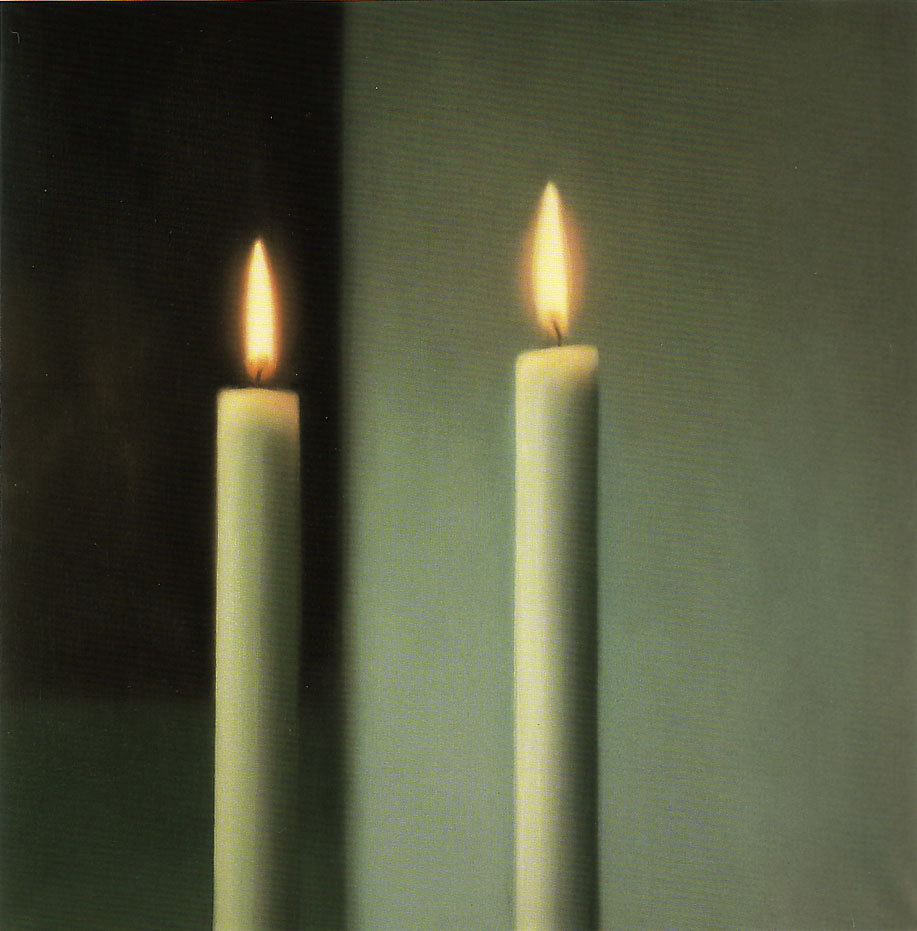
Gerhard Richter, Two Candles, 1982.
via Cave to Canvas
When I parted ways with the Art Institute, I firmly believed that I didn't need to work in the arts to be close to the arts. That I could pursue my passion for art in ways that were different than my career choices, opting to try a line of work, though still related to fundraising, that was not so closely aligned with my true passion for arts and culture. Reflecting on my last five months in my current role as a researcher at a consulting firm, I have gleaned, that a big part of me is yearning to assume my place in the art world. Lately, I find myself happiest when I am reading about art / exhibitions, viewing art / exhibitions, and talking about art / exhibitions. It has become so clear to me that my passion for art cannot be snuffed out.

So how do I negotiate this you ask? I can't exactly pour ashes over the fire and turn my back on what I know makes me happy - that's not my style. As my father likes to say, "Guttmans never quit" - and ain't that the truth? Rather than walk away from a piece of me that is flickering within my core, I am slowly feeding my burgeoning flame the kindling it needs to grow into a sweltering hot house that was the Great Chicago Fire, that is my alma mater's mascot, the Prairie Fire, and that maybe one day could be the flame of my future.

How I negotiate this yearning, this aching desire, is up to me. Lately, I've been pursuing art in my spare time. Visiting art openings around the city, taking my time when I walk through museum exhibitions to read every didactic plate, attending artist lectures, and reading every article the Internet has presented me (kids crawling on Donald Judd sculptures, Obama hatin' on Art History majors, the Molly Soda art appropriation "scandal") knowing full well that I am on my way to attaining fulfillment in my work with every effort (big or small) I make to get closer to this thing I love so intimately.

I attended a talk last night, given by the curator and "art worker," Dieter Roelstraete of the MCA. His discussion of the art world in terms of status gave way to the idea of those in the art world as being "art workers" or "art laborers" - that every role is important. From artist, to curator, to critic, to viewer, each role needs to work in tandem with another. That art cannot exist without the viewer, that the curator and critic cannot exist without the artist, brings about the point that the art world, while driven by status, is actually driven by the symbiotic relationship of these "art workers".

A person plainly asked him, how does one become a curator? To which he quite candidly responded:
One must take in a broad range of experiences. To learn to curate is a practice in looking. See as many exhibitions as you can, take stock of what you see.

So here I am. Pursuing the art world from the "outside" working my way back in. Initially as a viewer, maybe a small part as an artist, and one day as curator and critic. I savor ever moment I have with a work on view, cherishing the experience for the singularity of it. Reflection on viewing is part of attaining fulfillment for me, and I have a feeling my reflections have only just begun.

Saturday, December 17, 2011

Warhol at the Frist

Back in August I made a weekend getaway to visit a girlfriend outside of Nashville, Tennessee. After an early morning flight, we stopped for pancakes and coffee, before swinging by the Frist for their exhibition Warhol Live: Music & Dance In Andy Warhol's Work.

I really enjoyed this show because it was completely accessible. You need not know a thing about Warhol, Pop Art, or music and dance to be able to move fluidly and confidently through the galleries. The show was approachable and open - with gallery spaces bleeding into one another through the use of music playing intermittently. Films were projected on walls, couches appear for lounging, a silver clouds room was created to stage a screening of a Merce Cunningham performance, and a space was designated to recreate an Exploding Plastic Inevitable show (ie Factory era early Velvet Underground performances).

I had a lot of fun, and was happy to have a chance to play in the Silver Clouds and excited to view a clip from Horse (1965), a film I went to the Warhol Museum to view for my thesis. I even managed to sneak a picture with the clouds!!
   warholfristsilver clouds
m